In this critical analysis I will be exploring the narrative of Cloud Atlas (2012) and its unique concept of storytelling. I will be expressing the themes of Cloud Atlas and analysing the deeper meaning, hidden underneath the films structure and narrative. By applying the concepts and information I have learnt from the Principles of Storytelling unit, I will address the factors on which the film impacts the audience and how ideology effected the commercial success of the film.
Cloud Atlas is a film directed by Tom Tykwer and the Wachowskis and is based on the novel with the same title by David Mitchel (2004). Cloud Atlas tells us six stories that are divided by genre and time. However, they are ostensibly connected by fate and coincidence, as the main characters from each story find revelation and inspiration from their precursors, to conclusively change their story in a consequential way. It is a story about stories. About the distinctive ways in which we can convey an understanding of life from one person to another. Cloud Atlas does this from one generation to the next connecting each story and character by soul. Author David Mitchel best describes this, “we think we are islands but actually we are interconnected archipelagos of islands.” The interconnectedness of each main character in the book, is shown by the motif of a comet shaped birthmark however, in the film they change this by using the same actors to play different roles. Turning the journey of one soul into many. Essentially it is a signifier of a single soul being reincarnated, across different life times, fighting the same enemies, battling the same battles and yearning for the same freedom. Cloud Atlas brings up the notion of eternal recurrence and relies heavily towards spiritual concepts such as reincarnation and karma. Although the filmmakers welcome spiritual interpretations, they also wanted to explore secular perspectives. The first forty minutes introduces the narrative in a chronological order however, there is a particular moment when this structure is broken. There is no longer a chronological structure and the field opens up to intercutting between the sequences without any order. Instead, the narrative is structured with an internal connectedness and flow. Going from a linear structure to a nonlinear structure, similar to The Tree of Life (2011). This change makes more sense than any other structure as Tom Tykwer best describes himself, “you can stay with what you’re used to or you can go elsewhere and join us.” This structure change happens the same time we see one of the main character make a crucial decision, just like the audience having to make a choice after having forty minutes to prepare for it. Again Cloud Atlas diffuses the boundaries of each story and maintain their interconnectedness through music, mutual emotions and visual communication. Regardless of the audiences spiritual or religious believes, Cloud Atlas teaches us that our actions deeply impact the world around us. This is best captured into words by the character ‘Sonmi-451’ played by Bae Doona; “the nature of our immortal lives is in the consequence of our words and deeds and go apportioning themselves throughout all time.” This is a beautiful way of expressing karma or reincarnation on the grand cosmic scale.
The genre of the film isn’t completely clear. You could interpret it as a drama although the themes and conventions of each individual story suggests otherwise. From a slave plantation in the Pacific Islands to the dystopian city of ‘Neo Seoul’ the genre of Cloud Atlas cannot be resolved. However, the three main genres that Cloud Atlas depicts, are science fiction, drama and adventure. The conventions of these genres are shown through the use of mise-en-scene and locations of each singular story. The film starts on a slave plantation in the Pacific Islands in 1849 with Jim Sturgess’ character ‘Adam’, a lawyer from America taking on the contract for the plantation. We can identify the genre for this story as a drama. As this story exhibits real life situations along with the development of Adams character. This story also has intense social interactions along with conflicts and real life struggles. When sailing from the Pacific Islands back to America, Adam slowly battles a life threatening tropical parasite. While he is treated by a doctor, he writes a journal about his voyage which is then read by ‘Robert Frobisher’ played by Ben Whishaw. An apprentice of a great Belgian composer. As he works on his masterpiece, he writes letters to his lover, ‘Sixsmith’ in Cambridge. When his lover grows old those letters fall into the hands of ‘Luisa Ray’ played by Halle Barry. An ace reporter who uncovers a conspiracy threatening millions of lives. Her investigation is then turned into a thriller reviewed by Jim Broadbents character, ‘Timothy Cavendish’ a London based publisher. A writer he manages kills a critic causing his book sales to sky rocket. After the writer’s criminal family come after Timothy, he retreats to Hull when he finds himself in turned in a home for the elderly. After he escapes the care home he produces a movie of his adventure, which is then watched by ‘Sonmi-451’ played by Bae Doona. A waitress for a restaurant and a member of a genetically modified underclass of the dystopian city of ‘Neo Seoul’. She is then rescued by a rebel faction whose mission is to reveal the truth that keeps the corporate regime that keeps ‘Neo Seoul’ running. When she is captured by the state, the interview she gives before her execution becomes the holy text of a new religion. And is worshipped as a goddess by ‘Zachary’ played by Tom Hanks a Shepard on an island that was once called Hawaii before the fall. Zachary meets one of the last survivors of fallen civilisation as they both desperately try to preserve the last vestiges of advanced technology. Through the distinctive qualities of film, Cloud Atlas displays how each story is connected through narrative, like a long fabric sewn together. Again the way that the narrative is constructed is to further diffuse the boundaries between each story and emphasise their interconnectedness. Although each story has completely different genres and settings, they do share some symmetry and each story shares a major a cent or decent. Most importantly they share the same themes.
This brings us to the second theme of Cloud Atlas, predacity. This reveals the implications of this interconnectedness of cause and effect. Predacity is Cloud Atlas’ main source of conflict and can be seen in each individual story. The way individuals prey on individuals, tribes against tribes, corporations on their host societies and states against civilians within those states, all of which are examples we see in Cloud Atlas. Reflected as each character fights against power, greed, malevolence and other qualities that ultimately leads to victors and victims. This is reflected by a simple line of dialogue from the film, “The weak are meat, and the strong do eat.” Once we take the interconnectedness of the stories we notice that there is some truth behind this statement. We see that in each story the characters achieve some sort of victory over the conflict they are facing. However, these victories seem to be negligible as the progress leading up to the victory in each story is diminished by a new source of oppression in the next. Best put into words by ‘Robert Frobisher’ in his letter to his lover, “At this point in my life, all I know Sixsmith, is that this world spins from the same unseen forces that twist our hearts.” Cloud Atlas suggests that no matter what you do you cannot expel evil or injustice however, you can restrict it within your own self, your own heart. It is here that we have free will and the ability to make a difference however, we ourselves, are the ones able to accept it. Just like the characters in the film each have to search themselves and find a reason to fight against the oppression. Morality is also addressed in Cloud Atlas in both each individual story and character as well as how the morality of one character’s actions effects their soul in the next. Along with morality, karma is a key concept in Cloud Atlas. Karma is defined by the influence of a person’s actions on their future, including future lives. The best example of this is with Tom Hanks’ multiple roles. From the beginning he plays a doctor who attempts to poison and kill out of greed. This then carries out into the next story when Hanks plays a greedy innkeeper that extorts money from ‘Frobisher’ in order to keep his location anonymous. However, this greed dissipates and his character ‘Isaac Sachs’ takes a better turn, assisting ‘Luisa Rey’ to gain evidence that ultimately uncovers the conspiracy saving millions of lives however, dying because of it. Nevertheless, his next character still portrays acts of greed, committing a murder for publicity. Conclusively Hanks’ final character ‘Zachary’, is tasked with overcoming his selfishness of saving his village and family. It is this final challenge along with ‘Zachary’s’ actions and morality that displays the character arch from selfishness to selflessness, concluding with the character’s fate. This example of just one character’s soul, demonstrates how each character develops over each individual story. The way in which the filmmakers want us to view the characters is to draw us away from believing the action on screen and getting us to think about the action on screen. We are supposed to have a reaction seeing ‘Sonmi’ and ‘Hae-Joo’ playing ‘Adam’ and ‘Matilda’. Both are played by the same actors and both are coupled lovers, it is supposed to force our minds into making a parallel. The characters are not meant to be seen as individual performances but to be seen as how they fit within one another. By having the same cast appear and reappear and by forcing the theme of eternal occurrence, encourages the audience to think less about the stories individually and instead think of them in relation to each other.
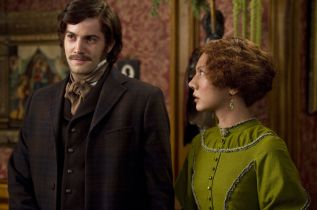

The narrative of Cloud Atlas is heavily influenced by contextual Ideology. Whether a book or a film, a text functions within a network of values and rules. It is these rules that dictate the way in which a film is produced. Looking at the choices made in the film, they seem to be based more on dominant ideology reflected by changing the roles of minority groups and the hierarchy within the narrative structure. Richard Dyer (2002, p.11) states;
“It is not merely a short cut. It is all these things and something more. It is the guarantee of our self-respect; it is the projection upon the world of our own sense of our own value, our own position and our own rights.”
Dyer postulates that when viewing stereotypical depictions, a dialogue is created when it is asked whose interest these stereotypes serve. Since the production cost of a blockbuster film is so high, a large dominant audience must be attracted to the film for it 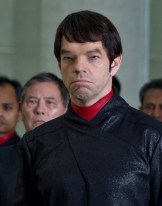 to remain financially viable. However, the way in which Cloud Atlas failed this is through the characters becoming flat and stereotypical. This can be seen as an effect caused by the way the blockbuster film industry works. An example of this is through the makeup of some of the Asian characters in the ‘Neo Seoul’ story. Instead of casting Asian actors for Asian roles the filmmakers decided to cast American actors for the Asian roles. Along with the Asian female characters being depicted within the film as replaceable clone servants as they were highly sexualized. Feeding into the stereotypes of submissive Asian females, Asians all looking alike and Asian labourers being cheap and replaceable. Again this is relating back to wanting the film to be attracted to a dominant society, in this case the western society. Casting famous American actors and applying makeup to make them look Asian. This caused a major racial upset, robbing roles from male Asian actors and diminishing the roles of the female Asian actors. The filmmakers also pointed out that although many actors donned yellowface and even whiteface, the directors had the guile not to put anyone in blackface. As this would be wrong and insensitive upsetting their audience. So why did the filmmakers decide to put actors in yellowface and not blackface? This has to do with ideology, wanting to appeal to their mass audience, America, whose ethnicity lies in the majority of Caucasian, African American and Latino Americans. However, it still stirred controversy which was what mostly turned the film into a commercial flop. Perhaps if they had instead cast Asian actors for the Asian roles, the film would have grossed a higher profit and more positive criticism. But of course this is due to the sextuple casting along with its recurring theme that all boundaries are conventions quoted in the film by ‘Frobisher’. Those boundaries include genre and class and sex and yes race. So the filmmakers were faced with a dilemma, either expel the reincarnation motif or apply yellowface to the actors. And as we know the directors went with the second option. Assuming the film was first cast by getting the protagonist for each of the six main roles, then casting the other roles around that. In the book ‘Sonmi-451’ focuses more on her evolution from servant to revolutionary, spending more time watching and learning about the world she inhabits. Whereas, in the film it takes a more action-adventure root however, the world remains the same. Set in the future where one of the last empires on a highly populated Earth, is a future high-tech Korea ruled by a corpocracy. It’s a mix of late capitalistic fetishized consumerism and an autocratic republic. Similar to North Korea and South Korea. This future Korea runs of a slave labour via the use of fabricants, which is what ‘Sonmi-451’ is. Like Blade Runner (1982) replicants they are very similar to humans albeit grown rather than born. The story of ‘Sonmi-451’ has several key players; one or two fabricants and a lot of natural borns, humans. All of the natural borns are played by non-Asians in makeup whereas the fabricants are played by Asian actors. The supposedly natural born characters are buried under unnatural faces and the supposedly fabricated characters, have the least amount of makeup. As we only see the fabricant actors out of makeup we subconsciously reject the actors wearing yellowface and align ourselves with the fabricants. So there might be a method behind it and the irony can somewhat justify the yellowface makeup.
To conclude Cloud Atlas leans heavily on the notion of eternal recurrence, which is often associated with spiritual concepts like karma and reincarnation. Diffusing the boundaries of each story through the distinctive qualities of film and emphasising their interconnectedness, leading to a structure where the stories are intercut based on the actions of the main character in each story. Regardless of your spiritual or religious beliefs; is the deeply intricate ways in which our actions impact the world around us. How each theme in the Cloud Atlas reveals the interconnectedness of cause and effect. As each character finds meaning and motivation in the beauty transferred to them from those who came before. Allowing each character to elevate their individual and particular struggles, to something that comes close to carrying a universal meaning. This is when we finally understand that the boundary between our heart is just a convention, waiting to be transcended. If we do this, then even the tiniest victory becomes one of significance. Emphasising that it only takes a small amount to preserve justice and goodness like a drop in a limitless ocean. To which Cloud Atlas adds “what is an ocean, but a multitude of drops?”
Bibliography
Blade Runner, 1982. [film]. Directed by Ridley Scott. USA: The Ladd Company, Shaw Brothers, Warner Bros
Cloud Atlas, 2012. [film, DVD]. Directed by Tom Tykwer, Lana Wachowski, Lilly Wachowski. USA: Cloud Atlas Production, X-Filme Creative Pool, Anarchos Pictures.
Dyer, R., 2002. The Matter of Images. Second Edition. London: Routledge. E-Book
Mitchell, D., 2004. Cloud Atlas. First Edition. London: Sceptre
Tree of Life, 2011. [film,DVD]. Directed by Terrence Malick. USA: Cottonwood Pictures, River Road Entertainment, Brace Cove Productions.

 Critical Analysis